
How to write a book and publish it in the 21st century
I have just published a guide (free) from Hub de Libros (Open Editorial Publishing Platform) where I describe how the models used to carry out many activities until a few years ago have changed radically thanks to technology.
Writing and publishing have also changed, with more opportunities than ever for anyone who wants to write and publish.
I do not like the terms self-published or independent author, at a time when large and well-known authors are switching to this publishing model, which offers more advantages than disadvantages.
That is why I prefer the concept of free author.
In this guide you can discover the steps you have to take to publish freely, its advantages over old publishing models (asking permission from traditional publishers), as well as some advice for writing even in the middle of a very busy life.
You can download it from https://www.hubdelibros.com/recursos, or obtain it on Amazon (the latter has the minimum price possible because Amazon does not allow directly setting the price of a work to free).
Below, I include the introductory chapter.
The Manifesto of the Free Author: How to write a book and publish it in the 21st century. Introduction chapter
What if I told you that you can write a book (even in the middle of a very busy life) and publish it so that it is read anywhere in the world, while also receiving income from it on a regular basis each month? This is a reality.
Hello, my name is Rafael Gómez Blanes and I am the CEO of Hub de Libros — Open Editorial Publishing Platform.
In the following pages we will show you how you can conceive a literary project, get it underway (even if you have a very hectic life), and publish it so that it is available to millions of readers, just as I have done.
But before that, I want to talk a little about myself.
My activity as an author began in 2014. I then launched a book about my activity as a software engineer (“The Programmer’s Black Book”). What I began almost anecdotal in that first book now constitutes one of my professional activities.
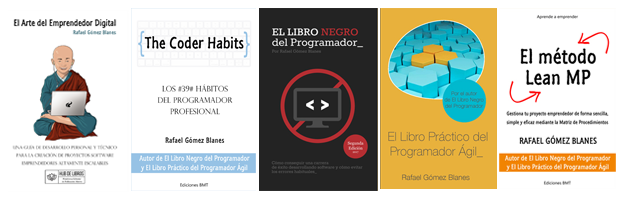
(Some of my books available on Amazon and Google Play)
At the time of writing, I have five technical books and two published novels to my name.
Every day, and I mean every day, and for years, some of my titles have been sold somewhere in the world: Spain, the United States, Mexico, Chile, Canada, etc., and even Japan, despite the fact that only one of them is translated into English at the moment.
Thanks to that experience as an author, we created Hub de Libros to help many others follow the same path I have traveled over these years.
I maintain that “publishing” is a Right, just like Writing, as Julia Cameron would say.
If you had not realized it yet, publishing has been “democratized”.
Over these years, an important factor has come to change the way readers read, consume, and buy books, and also the way authors write and publish, and that factor is none other than technology. In other words: “publishers need authors, but authors no longer need them.”
This change is neither good nor bad; it is simply that some business models evolve, new ones emerge, and others disappear.
But for authors, this is great news.
Those times are long gone when we needed the permission of a company (which we will call a “traditional publisher”) to tell us and certify whether our work is good or not. What are readers for, if not?
The only measure of the success of your work is the opinion of the readers. That is it. This is a declaration of principles at Hub de Libros.
Traditional publishers have an important role in the book industry and culture, no doubt about it, but it is no longer a requirement to go through commercial filters or any other type so that your work reaches the widest audience possible.
Technology has allowed a change of model in this activity, just as it has disrupted all areas of the economy, and, you know what? It will continue to do so whether we want it or not.
As writers, let us take advantage of it.
Whether we like it or not, technology has come to stay and radically transform all the economic areas of our lives in society.
Culture (and publishing), too.
Some data:
- The best-selling authors in the biggest bookstore in the world (Amazon) are self-published. I admit that I do not like the term “self-published,” but we will talk about that in the following pages.
- The e-book continues its unstoppable growth (we can read from eReaders, mobile phones, tablets, etc., from any electronic device), not just on paper. If you think about it, it is the natural and logical consequence.
- In the way we write and produce content, technology is reducing friction and cost dramatically, turning ideas into published works.
The history of the book is not about its disappearance but its transformation.
And the great opportunity is not only to sell more, but to create a more direct relationship between the author and the reader.